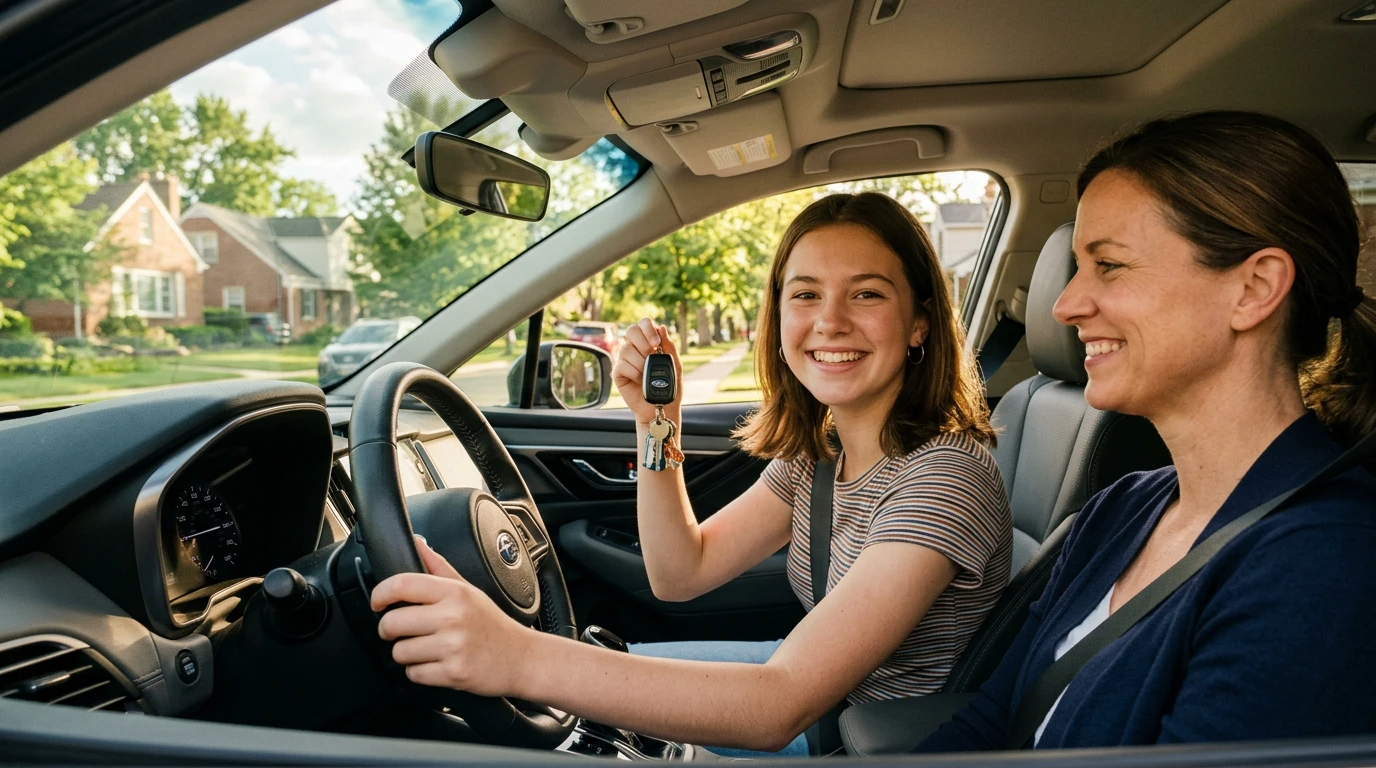
It's graduation season, which means our phones light up with the same question every June: “Our kid just got their license — how badly is this going to wreck our insurance bill?”
Short answer: it's going to go up. There's no way around that. But how much it goes up — and how long it stays there — depends a lot on choices most parents don't realize they're making. Here's an honest walkthrough for families across Illinois, Indiana, Michigan, Minnesota, and Wisconsin.
Why Teen Drivers Cost So Much to Insure
It's not personal. Drivers 16–19 are involved in roughly three times more crashes per mile than drivers 20 and over, according to the IIHS. Carriers price for that risk, and there's no version of the math where a new 16-year-old looks cheap.
What that means in practice for our region: adding a teen to a typical two-car family policy generally increases the premium 50% to 100%. A family paying $1,800/year for two cars and two adults often jumps to $2,800–$3,600 when a teen is added. That's the honest range. Anyone quoting you dramatically less is probably stripping coverage you actually want to keep.
Should You Add Them to Your Policy or Get Them Their Own?
Almost always, add them to yours. A standalone policy for a 16- or 17-year-old will cost significantly more than the increase you'd see by adding them to a family policy — usually two to three times more. The exception is if your teen owns the car outright in their name and lives at a different address (going off to college far away, for example).
For most families, the playbook is: add the teen as a driver on the existing policy, assign them to the lowest-value car in the household, and keep them there until they've built a few years of clean driving history.
Which Car They Drive Matters More Than You'd Think
Carriers in the Midwest now use what's called vehicle assignment: each driver in the household is matched to a primary vehicle for rating purposes. The cheapest setup is almost always:
- Teen assigned to the oldest, lowest-value car with the smallest engine
- That car carries liability-only or higher-deductible physical damage coverage
- Parents stay on the newer or more valuable vehicles
The temptation, especially around graduation, is to buy a new or near-new car for the teen. We get it — safety, reliability, looks like a nice gift. But a 2024 SUV with a teen primary driver and full coverage can easily add $1,800–$2,400/year to your premium versus assigning the teen to a 2014 sedan with liability-only. That's real money for four straight years.
The Discounts That Actually Move the Needle
Most carriers advertise a long list of teen discounts. A few are meaningful. Most aren't. Here's what actually helps in our market:
- Good student discount. 3.0 GPA or better, usually saves 8–15%. Submit the report card every semester — carriers do verify.
- Driver's education completion. Most Midwest states already require this, but completing an additional certified course (not just the high school class) often unlocks an extra 5–10%.
- Distant student discount. When your teen leaves for college more than 100 miles from home and doesn't take a car, several carriers will drop them to an occasional-use driver. Savings can be 20–35%. This one is huge and often missed.
- Telematics / safe-driving programs. Several carriers in our footprint now offer programs where the teen's phone or a plug-in device tracks driving for a few months. Good behavior earns 10–25% off at renewal. Worth doing if your teen is a careful driver and doesn't mind the monitoring.
- Multi-policy discount. Bundling auto with your homeowners or renters policy gets you 10–25% off the whole package — and that discount grows in dollar terms when the teen is added because the auto premium itself is bigger.
What we generally don't chase: brand-loyalty discounts, paperless billing discounts, and the “app sign-up” discounts that save $12/year. They're real, they're just not the lever that matters.
State-by-State Notes for Midwest Families
- Illinois. Graduated driver licensing (GDL) is strict — first-year violations can push a teen into a more expensive rating tier for years. The new 2026 rate environment means even small infractions are pricier than they used to be.
- Indiana. Required minimum liability limits are low ($25K/$50K/$25K), but those limits are nowhere near enough for a teen-involved accident. We strongly recommend at least 100/300/100 for any household with a new driver.
- Michigan. Post-no-fault-reform Michigan still requires PIP coverage, and the choice of PIP limit matters even more with a teen driver. Don't default to the lowest tier without understanding what you're giving up.
- Minnesota. One of the most competitive teen-driver markets in the country — multiple regional carriers compete aggressively for family business. Worth re-shopping when your teen turns 16, 18, and 21.
- Wisconsin. Minimum limits are 25/50/10 — again, far too low for a household with a new driver. Wisconsin also has strong telematics offerings from regional carriers that we use frequently for teen drivers.
The Umbrella Policy Conversation Most Parents Aren't Having
Here's the one we wish more families thought about before the keys change hands. A serious at-fault accident caused by your teen can produce liability claims that exceed your auto policy limits — sometimes by a lot. If a jury awards $1.2M and your auto policy tops out at $300K, the rest comes from you.
A personal umbrella policy sits on top of your auto liability and adds another $1M, $2M, or $5M of protection. For most families in our footprint, a $1M umbrella runs $200–$400/year. That's the cheapest insurance you'll ever buy — and adding a teen driver is the moment to seriously consider it. Most carriers will require you to carry 100/300/100 auto limits as a prerequisite, which you should be at anyway.
Five Common Mistakes We See
- Not telling your carrier. “We'll just add them later” can void coverage if there's a claim. Once your teen has a license and access to your cars, they need to be on the policy.
- Buying the teen a fast or flashy car. Sport coupes, turbo sedans, and large SUVs all rate higher. A 4-cylinder sedan or small crossover is almost always cheaper to insure and safer in the data.
- Dropping comprehensive and collision on the parents' cars to “save money.” The savings rarely justify the exposure on newer vehicles. Better to take the higher deductible.
- Not re-rating at 18 and 21. Teen rates step down meaningfully at 18, 21, and 25. If your carrier doesn't automatically re-rate, you're leaving money on the table.
- Forgetting the college-away discount. Easily the most-missed savings. If your kid heads off to school in the fall without taking a car, call us — we'll make sure the carrier knows.
A Quick Word on Driving Behavior
This isn't insurance advice exactly, but it matters: the single biggest predictor of whether your teen's premium stays high or drops fast is whether they get a ticket or have an at-fault accident in the first three years. One speeding ticket can raise the household premium by $400–$800/year for the next 3–5 years. Worth having the conversation now.
Want Us to Run the Numbers?
If you're about to add a teen driver — or you already did and the renewal sticker shocked you — send us your current declarations page. We'll quote it across multiple carriers, show you what discounts you're missing, and walk you through whether a higher liability limit plus an umbrella actually saves you money over the next four years. No pressure to switch.
And if your teen's graduation gift is a car, talk to us before you buy. The right vehicle choice can save you four years of premium — sometimes more than the dealer's “great deal” ever did.
Reach out here and we'll take a look. Congratulations to the graduates.